
In Memoriam: Reflecting on the 2025-26 Ottawa Senators
Written by: Trevor Shackles
© André Ringuette/NHLI
What a strange season that was. For most of the season, the Ottawa Senators were on the outside looking in, and it seemed as if it just wasn’t going to be their year. Then for the final few weeks, they were all of a sudden back in after clawing their way back for 30 games, and just like that…it all ended after merely a week of playoff action. So how did we get here? And what should we take from a very up-and-down season? To call 2025-26 a success or a failure is too reductive, because the reality is that there is so much nuance involved, and it’s why I felt the need to write this article. In addition, it’s been almost a year since my last article at Silver Seven Sens, so I definitely had the itch to write.
There are many positives to take from 2025-26, but also some negatives. Here are my biggest takeaways from the season that was:
Positives:
Possession Uptick
This is the biggest positive for me because you should be able to translate it to next season. The Senators jumped from 15th in CF% and 19th in xGF% to 5th (52.85%) and 3rd (54.54%), respectively. That’s a big improvement from a mediocre possession team to one of the best in the league. It’s clear that Travis Green’s messaging has gotten through, and they were dominating games for most of the season, even if they weren’t always getting the bounces or the saves that they needed. 3rd in xGF% is the highest the Senators have ever been in the data-tracking era (post 2007), with 2009-10 surprisingly being the next closest at 4th-best in the NHL that season (52.50%). We haven’t seen a Senators team be this strong with the puck in literally 20 years, and that brings me hope moving forward.
Commitment to Team Defense
Obviously, with strong overall possession stats, you’d expect the defensive numbers to be great as well, but I think most people would have assumed that it was their offensive power carrying them, not the other way around. However, Green and the coaching staff turned Ottawa into one of the stingiest teams in the league. They were 2nd in the NHL in 5v5 xGA/60 at 2.32, and also 2nd in all strengths xGA/60 at 2.82. It’s unheard of for an Ottawa team to be known as an elite defensive team, but it was true this season. This point is similar to the previous one, but I think it’s important to distinguish their defense because it’s much harder to commit to than offense. We saw players like Brady Tkachuk, Dylan Cozens, Drake Batherson, etc. see their defensive results improve, and that wasn’t just random. Everyone bought in, and it showed real maturity.
Ullmark Exorcising Playoff Demons
One of the biggest storylines all season long was Linus Ullmark, first with his streaky play, then with his leave of absence, and finally with his return. He faced a ton of criticism for his .891 SV% and -12.8 GSAx in 49 games, and for good reason—he was simply not good enough. However, so much of the narrative about him was so overblown and not fair, especially considering how open he was about his mental health struggles. Furthermore, once he came back in late January, he was pretty much a league-average goalie the rest of the way, which is all Ottawa needed to go on a run. Lastly, not only was he good enough in the playoffs, he was exceptional. In four games, he had a 6.7 GSAx, which is 1.675 goals saved per game. The fact that they got swept is infuriating, but it’s nice to know that Ullmark can show up when it matters most, as he was by far their best player in the playoffs. The Senators still need a 1B goalie behind him, but at least we don’t have to hear about him not performing in big spots.
Spence Breakout
Jordan Spence was acquired for just a 3rd and a 6th round pick, and he was probably the best bang for your buck acquisition of the summer. He put up 31 points in 73 games and was phenomenal in so many different aspects of the game:
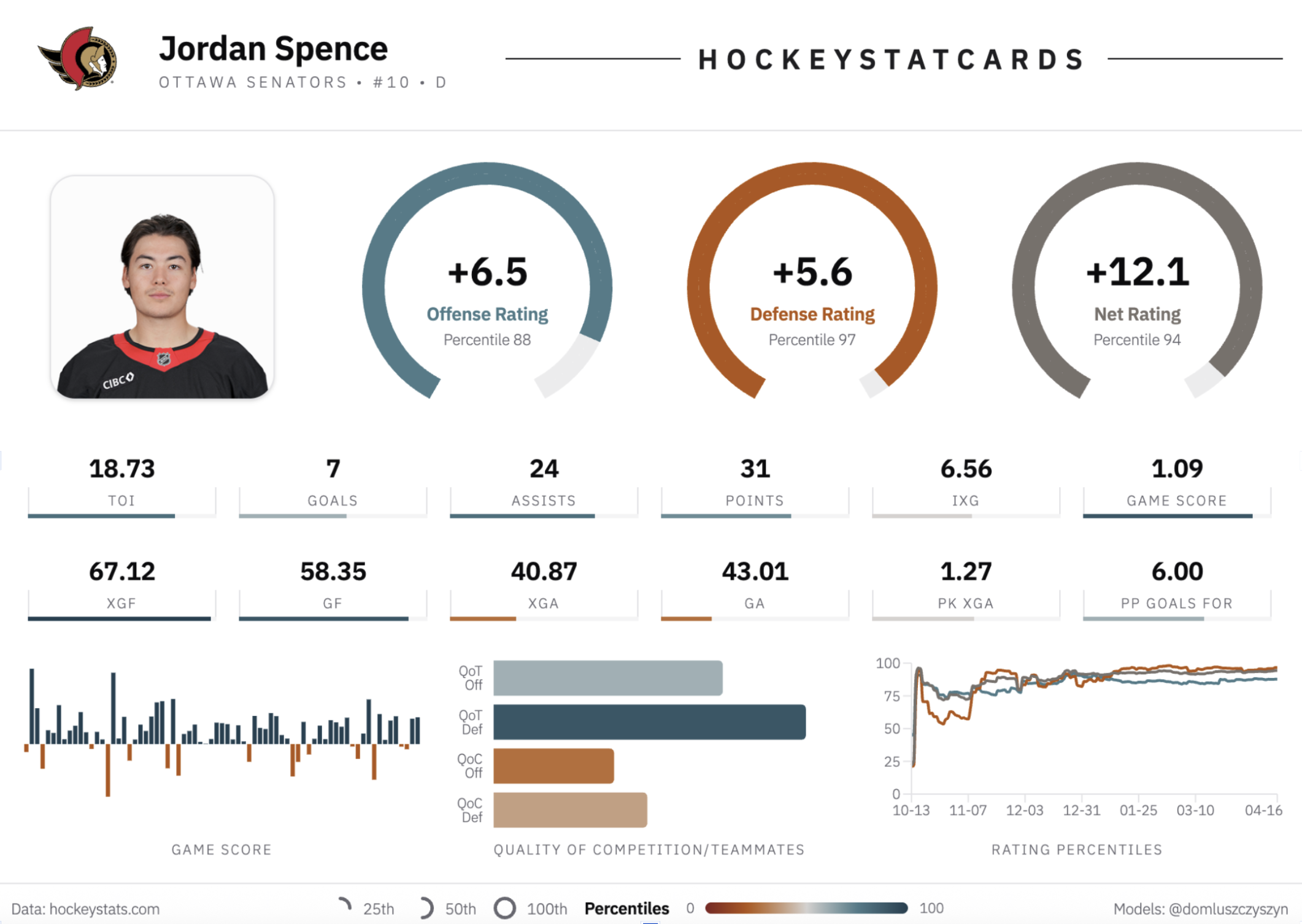
He played on the third pairing for most of the season, and it was such a luxury to have a great puck-mover like him in a depth role. But when they went through a slew of injuries to their defensemen, Spence stepped up admirably in a top-4 role and more than held his own. He did so well that I’d feel very comfortable giving him a long-term extension this summer. The 25-year-old is an RFA, and I see no reason why they can’t give him 5-7 years at a reasonable rate, especially considering his asking rate probably wouldn’t be that high. A defense corps of Jake Sanderson, Thomas Chabot, Artem Zub, and Jordan Spence is elite.
Great Depth
Besides 19 games from Kurtis MacDermid and 10 games from Hayden Hodgson, Ottawa hardly ever gave minutes to tough guys who are only there to fight. Beyond that, they barely had to give minutes to anyone who wasn’t capable of contributing, which was such a nice change of pace compared to essentially every other season for the past 20 years. Not only was their third line a fantastic shut-down line, their fourth line held its own with the likes of Lars Eller, Fabian Zetterlund, Nick Cousins, Warren Foegele, and Stephen Halliday. In addition, they had defensemen like Nikolas Matinpalo, Lassi Thomson, and Carter Yakemchuk step up admirably in desperate times of need. It was a breath of fresh air being able to rely on players and not have Dylan Gambrell and Travis Hamonic at the end of the lineup.
Resiliency in the Regular Season
The Senators sat nine points out of a playoff spot on January 24th. But in their final 31 games, they went 21-6-4, making it all the way to 99 points. The talk was always that the just needed average goaltending, and they got it. People kept saying things like “they need to go on a .650 winning percentage streak the rest of the way” or something similar, and they beat that by a mile—it was .742 over the final 31 games. They were essentially in playoff mode for the final two and a half months of the season, and the resiliency shown in order to get back into the playoff race and even clinch a spot with two games to go was incredible. They had to have the belief they could do something special, and they were very committed and accomplished the first part of their goal. Obviously, it didn’t end well after that, but 31 games of elite hockey is nothing to scoff at.
Special Teams
You wouldn’t have known it based on the playoffs, but the Senators actually had the league’s 8th-best powerplay in the regular season at 24%. That’s a slight uptick from 23.8% (11th) last year, which is nice but not too meaningful. The penalty kill was absolutely dreadful for a good chunk of the season, but a lot of that was because of the goaltending. Things also drastically changed when Mike Yeo took over the penalty kill coaching duties, as they went from 71.6% to 83.1% afterwards. That was still only 75.5% on the season, but the marked improvement shows me that they can make those changes. The powerplay in the playoffs is a topic for later on, but both special teams were on fire once Ullmark came back.
Competency with Organizational Vision
This one is much more subjective, but I feel like more than ever, I can sense that there is a plan for the organization. Whether it be the marketing, fan engagement, plans for LeBreton, or the methodical approach to team-building, it just seems like they are trying to be an excellent organization. I couldn’t have said that for the Melnyk-era Senators, because there was always something negative you could point to. There has been drama with the team for sure, but none of that has been the fault of the team, so I feel confident with where they’re at.
Now here are the negatives…
Negatives:
Horrendous Playoff Performance
It’s hard to overstate how disappointing the four-game series against the Hurricanes was. Not only did they get swept, they never had a lead, looked inept on the powerplay, could not bury great chances, and were just making dumb decisions that they usually didn’t make. Full credit to the Hurricanes for playing exactly how they needed to, but it was also baffling to see Ottawa play so well for two and a half months and then play like…that. It was also frustrating that they couldn’t seem to make any meaningful adjustments to how Carolina was playing against them. The powerplay only mustered one powerplay goal in 19 opportunities, and most of that is because of poor execution, but some of that has to come down to lack of proper game-planning as well. Hopefully they’ll be able to learn from this, but four similarly infuriating games was not a good way to end the season.
Slow Start Again
It’s always a theme in Ottawa and it’d be great to not have to worry about it one season, but the Senators started out…fine. They were 2-4-1 immediately, but then got to 8-5-3 and 12-7-4, which put them within striking distance. However, they then dropped to 13-12-4, and kept yo-yoing back-and-forth until their run began in late January. I can’t wait for a season where they are just in a playoff spot all year long.
Too Long to Address the Backup Spot
This is one that even Steve Staios admitted, as he said that he “didn't do a good job in the backup position.” Leevi Merilainen was expected to be a solid #2 to Linus Ullmark, but instead he was quite literally the worst goalie in the NHL. In 20 games, he posted an .860 SV% and a -.948 goals saved above expected per 60, which was the worst amongst 66 goalies to play 20+ games. https://moneypuck.com/goalies.html. It didn’t help that Merilainen was thrust into the starters role when Ullmark was out for his leave of absence, putting every Leevi start under the microscope. He looked incredibly solid as a rookie for 12 games in 2024-25, but he was a shell of himself this season, and Staios took far too long to address it. He finally added James Reimer in January, who posted an .886 SV% in 14 games, which was not great either, but much better than Merilainen. Let’s hope Staios can be more proactive with roster decisions.
Core Getting Older and Closer to UFA Status
It’s funny how quickly a competitive window can close before you even know it. NHLers peak around their mid-to-late 20s, and the Senators have some core pieces like Chabot (29), Tkachuk (26), and Batherson (28) who might already be at their peaks. Stützle (24), Sanderson (24), Pinto (25), Cozens (25), Greig (24), and Spence (25) are a few years younger, but Ottawa can’t be wasting their prime any longer. Some of these players are getting closer to free agency as well, with Tkachuk and Chabot being two years away, and Batherson and Zub being one away. This isn’t an old team at all, but you want to maximize your competitive window as much as possible, and another season without a deep playoff run is disappointing.
Not Many Assets to Use in Deals
We know how badly Steve Staios wants to add to this roster. We’ve heard countless rumours about him going big-game hunting, but it’s been very challenging because they don’t have the pick/prospect capital to get it done. They have young NHLers, but they need to keep most of them if they want to actually improve. Some of this lack of depth is because of Pierre Dorion, but Staios has been in charge of the last two drafts, and they haven’t exactly accrued a ton of blue-chippers. Yakemchuk is hopefully a big part of the team moving forward, but for that very reason, he’s probably not someone they want to move.
Beyond that, the system is bleak…There’s Lucas Beckman who’s dominated the QMJHL, Halliday who I still like as a 40-50 point player, Logan Hensler who was a first-rounder, Blake Montgomery who just began in the AHL, Dmitry Isayev who lit up the MHL, and some others, but none of those players are really going to headline a trade package. It’s hard to imagine how this team is going to get meaningfully better when their scouting has been so bad that they don’t have anything to entice others with. Which bleeds into the next point…
Desperate Need of Another Top Scorer
Ottawa doesn’t have the assets to get this top scorer, but they definitely need one. Although they finished 8th in the league in GF/60 (3.35) and 11th in goals for above expected (+3.11), it was clear that they didn’t have enough firepower in the playoffs to get past the Hurricanes. They struggled mightily to make creative plays, and when they did get grade A chances, they simply failed to convert them. Drake Batherson is probably their best pure goal scorer, but his 33 goals might represent his peak. Furthermore, Stützle had 34 goals this season and had 39 before, but based on the number of chances he gets, he should be potting 50+ easily. That lack of finish hurt them badly in the playoffs.
Dylan Cozens and Brady Tkachuk can score a fair amount as well, but none of these players are known as true snipers. I really like having those four in their top-6, but beyond them, they really need someone else who can play with Stützle, because it shouldn’t be Warren Foegele or Fabian Zetterlund. Names like Jason Robertson, Jordan Kyrou, and Robert Thomas would be a dream for the Senators, but it seems very unlikely they’d be able to get that done.
Not Having the “It” Factor
This is similar to the previous point, but it felt like Ottawa always needed to be perfect to win their games. And credit to them for deserving to win so many nights, because they were a dominant possession team. But the best teams in the league are able to find ways to win even when they don’t have their A game, and the Senators rarely did that. Don’t get me wrong, I love how they looked most nights, but they also lost many times where they should have won but didn’t because of a poor line change, bad bounce, or awful goaltending.
Ottawa had 19 comeback wins this season (tied for 12th), with most of those “comebacks” coming earlier in the game, because they were tied for 27th in third period comebacks with just four. Then you have a team like the Montreal Canadiens who were constantly down a goal or two late in the game (10 times in the third), just to come back and win in overtime. Overall, they came back 26 times in games. That “it” factor isn’t always sustainable, but it sure is easier to have the more talent and scoring ability you have.
Noise Around Tkachuk
This is kind of the territory that comes with having a Tkachuk brother as your captain, as there will always be rumours about Tkachuk wanting out of Ottawa until he either retires or leaves. This season had a ton of talk amongst the fanbase about whether his heart was really in it, as although he had a solid season production-wise with 59 points in 60 games, he was easily neutralized in the playoffs and didn’t seem to be dragging his team to victory like he had done so many times in the past. A lot of that is anecdotal, but I don’t think it was nothing. He was also under heavy scrutiny for things like his podcast, his visit to the White House after the Olympics, but he has never once said he wants out of Ottawa, and it’s odd that so many people assume he does.
With two seasons left on his contract, I do think it’d be negligent to not at least have a conversation with Brady about his willingness to re-sign in a year or two, because if not, then he needs to be on the block. However, I’d much rather add to this core and keep him around because despite his poor playoff performance, he’s a very valuable player who should be able to help this team win. Regardless of how you feel about him, it’s not good for the team to have all this noise about Brady all the time, and I wish we could just get an answer one way or the other if he wants to stay and will be able to stay or not. If he wants to be a part of the solution, I think you have to make that work, because you probably regret doing that down the line.
To quote one of my favourite tweets, “a lot of people think the point of sports is that your team will win and then you will be happy. That is not the point of sports. The point of sports is to be sad in a group.” And there’s no group of people I’d rather be sad with than the Sens fanbase. Plus, from now until they’re eliminated next season (or win the Cup??), we’ll always have hope. As always, thanks for reading. It’s been almost a year since my last article, so I had a lot to say. Until next time…Go Sens Go.